Showing posts with label health. Show all posts

Korea's Drinking Culture and Why I'm a Teetotaller


Saturday night and Sunday I spent with a group of mostly Koreans and some foreigners at a martial art excursion. This had not been my first such an outing with Koreans, so I expected there to be a lot of drinking and therefore prepared myself psychologically for it. As I am a teetotaller, I need such preparation. In general, teetotallers are a minority, but here in Korea with its extreme drinking culture teetotallers are almost non-existent.

Sometimes they start 'em young.
Image Source
If you do not drink in Korea, you are practically ostracised, for almost all social outings include alcohol. Somebody that doesn't drink with the group is considered unsociable and rude. I remember one occasion where I joined a group of Koreans and when I refused to drink I was basically told to leave by one person. Another senior Korean with whom I have close ties came to my rescue and persuaded them that I should stay since I am his “chinggu” (friend) and explained that it is part of my “religion,” which is a half-truth. However, I'm sure that had it not been for me being a foreigner I would either have needed to leave in shame because of my insult for not drinking with them, or I would have had to conform and drink with the group. I have met some “teetotaller” Koreans in Korea who would accept one drink and drink a little of it, just so that they do not come across as insulting. Some Koreans that do not wish to drink come up with stories like being sick or that they are taking medicine with which they are not allowed to use alcohol. However, even with some people showing the medicine as proof, I've witnessed the extreme pressure they receive to drink at least half a glass of soju. While foreigners can get away with not drinking, they will often experience severe pressure and may find themselves indirectly ostracised for being unsociable.

A drunk Korean passing out in public.
Not that uncommon a sight, actually.
Image Source

There are some Korean subcultures that do not drink, whom are part of so-called sectarian faiths such as Seventh Day Adventists, Jehovah's Witnesses, and Mormons. Because these Koreans are part of their own communities they at least have a social life. Koreans who do not belong to such religious persuasions are, as I mentioned already, ostracised and struggle to make friends. Even Koreans from these religious groups have a hard time, particularly in their work place. It is customary for colleagues to go drinking together after work, and refusing to do so, particularly if one's senior or boss suggested the drinking, is considered terribly rude, and even disrespectful. In that sense, not drinking could sometimes cost you your job.

Bottles of soju -- Korea's most famous
alcohol comparable to vodka.
Image Source
Had drinking in Korea merely been one or two beers, it would not have been that bad. Unfortunately Koreans take social drinking to the extreme. Drinking often involves drinking games and other group-pressure drinking. Hearing Koreans shout “one-shot”, i.e. gulping down your glass in one go, accompanied with the encouraging cheers, is not unusual. One's ability to “take a drink” is equated with being “strong”. I guess this is not a uniquely Korean thing, but in Korea it really seems to be a continued test and senior citizens going out with their friends do not seem to take it any lighter than when they were youngsters drinking themselves into a stupor. Seeing old Korean men ridiculously drunk is as common as seeing dead-drunk college boys.

Two older Korean friends passed out on the street
together after a night of heavy drinking. Or, at least,
that's my assumption of this picture.
Image Source

There is a small movement amongst upper class Koreans to drink wine. Since whine is so expensive, and since it is enjoyed slowly, wine drinkers tend to drink far less. Wine drinking in Korea is in many cases just for pompous show, like wearing a very expensive name brand suit, and going to art exhibits just for the pretence of appreciating art, but at least wine drinking is giving a way out to some Koreans who would like to socialise without getting completely knackered.


Soju advertisements usually involve a
sexy Korean woman, showing lots of skin
and curves, that enjoys to drink and party.
There is undeniably a sexual connection
made with drinking soju.
The thing that disturbs me the most about Korea's terrible drinking culture are the associated ethics that go with it. When Koreans misbehave while drunk, they are often excused. This is often true even when laws are broken. Here's another example of the shady morality of a drunken culture. So I once went out with a mixed group of foreigners and Koreans. One foreign girl got terribly drunk and started to behave awfully bad. She also became a danger to herself; constantly falling about and hitting her head. She refused to lie down and rest. Two Korean guys told me—and I think they are from different parts of Korea so this must be a common sentiment—that if she was a Korean girl they would just knock her out. They actually showed me the points where they would hit her. Being a martial artist I recognised the pressure points (temple; side of the neck; and somewhere else I'd rather not mention) and realised that these are indeed points to knock someone out with, so they are actually talking from experience. Did you get this? In Korea, it is common and acceptable to hit a rowdy drunk Korean woman unconscious. Eventually the foreign girl in our group did go to sleep without being knocked unconscious. The next morning she had no recollection at all of the previous night. Of course, nobody was angry with her for her misbehaviour—she was drunk after all. But the thing that disturbs me is that she could have been taken advantage of, i.e. raped, were she amongst a different group of people, and she would not have been any the wiser the next day. I'm wondering how often this sort of thing actually happens in Korea. In a culture where ridiculous amounts of alcohol consumption is socially acceptable and even socially encouraged, where drunken misbehaviour is excused, and where knocking out difficult drunk women is common (something I reconfirmed with some of my male students), taken advantage of an unconscious woman while you are drunk yourself, doesn't seem far fetched to me at all.

Luckily for this girl, Korea
is relatively safe.
Image Source

So why don't I drink alcahol? There are a couple of reasons really. The first reason I do not drink is as a statement. It is for the same reason I do not smoke. My father did. He smoked and it made him stink and I swore that I would not be like him. There was also a patch during which he drank and became aggressive. I remember clearly how my brother and I would hide (and sometimes throw away) his whiskey because of how we hated the way it changed his personality. It took him a while, but he eventually realised the negative impact his drinking had on us, so he stopped excessive drinking. I respect him for caring enough for us to choose us over the bottle. Nonetheless, the negative associations with alcohol was set, so I also swore not to be like my father, who continued to drink socially. Second, many people on my maternal side of the family are alcoholics. In particular my uncles, one of them my godfather whom I always looked up to. I saw how the drink had destroyed both their lives and their families and it disgusted me. It also came as a revelation to me that since I take after my mother's side of the family, I probably have a predisposition towards becoming an alcoholic myself. I know I have an addictive personality, so I'm not taking any chances. Later, when I became a Christian and accepted the scripture that says our bodies are temples of the Holy Spirit and that therefore healthy living is part of our act of worship, I decided to live a healthy life style. This is in part the reason why I'm a (flexible) vegetarian, why I avoid frequent consumption of caffeine, why I exercise even though I often do not feel like it. Finally, I honestly do not like the taste of alcohol. I once tried to drink Amarula Cream, thinking that I'd at least enjoy the taste since a like fruity, creamy stuff. I do like cherry liqueur dark chocolates after all. Regardless, I had to boil the Amarula Cream for quite some time to get rid of the alcohol taste. Last year I was in a hotel by myself and there was beer in the bar fridge. Being alone I thought I'd just try it a bit--I'm far from anybody who knows me, nobody would know. I took maybe two sips and can still honestly say that I really dislike the taste. If it is indeed an acquired taste, it is a taste I'd rather not acquire.

I'm not against people temperately consuming alcohol. There are many people who seem able to enjoy it in moderation only. Although I do not, many of my friends enjoy a drink on occasion. I am, however, against drunkenness and am definitely against Korea's excessive drinking culture. I strongly believe that Korea would be much better off without this element in its society. It is complete nonsense that a person cannot have fun without alcohol, that one cannot be sociable without drinking. And if it is the case for some timid people who needs the bravado of the bottle, the severe price Korea and its families are paying because of alcohol is not worth it.

In this post I focussed on a very negative aspect of Korea, sure. There are, however, many other positive things about Korea otherwise I would not have lived here for nearly five years now. Korea is cool.

"Across the Universe" and Other Cravings

I've been in the mood again for one of my favourite movies, Across the Universe, lately. I wrote about it before. The video below is a scene from the movie in which Evan Rachel Wood covers the beautiful Beatles' song "Blackbird".


Whenever I crave for something, be it food, or music, or visual stimuli, I always wonder what is the cause for the craving. You see, our cravings are signs that our being has a lack of something. As you probably know, I'm mostly a flexible vegetarian so I almost never eat meat, and don't enjoy red meat and if I were to eat it, it has to be cooked very well done. However, on occasion, once a year maybe, I may suddenly crave medium done red meat. What this tells me is that my body is lacking iron. Usually when I take an iron supplement or just eat some spinach the craving disappears. The same principle applies to other cravings in our life. What I'm wondering is, what is it in or about Across the Universe, that my soul has a need for?

Rain Cast as Buddha

On Sunday I went to the concert venue for Rain's performance. Unfortunately I came down with a bad cold / flu a few days before and while waiting there for the concert to start I just felt increasingly awful. Eventually the prospect of all that loud noise and bright lights and many people got the better of me. These are not things you want to experience while feeling under the weather. In the end I decided to go back home. A friend of mine did go and she said it was a great concert; it's a pity that I missed it.

Now what's this about Rain and the Buddha, you may ask?


Have you noticed how much Rain looks like depictions of the Buddha? The same serene smile, the pleasant narrow eyes, the slight pudgy nose, even similar big ears. Rain has really big ears! I'm of course referring to the younger slimmer (Indian) Buddha, not the older fat (Chinese) Buddha. 


It's not that far fetched an idea that a Korean entertainer should depict the Buddha. After all, the Buddha have been depicted in many films before, including a Korean film from 1964 on the Seokgamoni Buddha (the Buddha at the moment of enlightenment).

Seokgamoni 석가모니 (1964)

Let us not forget that even Keanu Reeves played the Buddha once. In the 1993 film Little Buddha, directed by Bernardo Bertulucci, Reeves was casted as Siddhārtha Gautama, who became the Buddha -- the "Enlightened One".  

Keanu Reeves in "Little Buddha",
in the role of Gautama Buddha.
Surely an Asian actor would look more like the Buddha than an Hawaiian, albeit racially mixed, actor like Reeves.

If you had to put Reeves and Rain next to each other and compare their characteristics, including acting abilities, they would probably come to a tie. They have even both acted in Wachowski Brothers' movies: Reeves in The Matrix films and Rain in Ninja Assassin. However, Rain will definitely get bonus points for being Asian, his bigger ears, and more serene Buddha-like smile.

If ever I had the opportunity to make a film about the Buddha, I'd cast Rain in the leading role. 

Shaking Hands

Image Source

I don't like shaking hands. Hands are tools and tools get dirty and exchanging tools is the same as exchanging germs. I am all too aware of where I put my tools, the places I scratch, the things I touch. For this reason I spare you the exchange of microbial spores and other germs -- please spare me from your filth too.

I really don't know why the ritual of shaking hands is still such a common practise. Personally, I'd rather hug somebody than shake hands with them. During a hug, there are layers of cloth separating actual skin-to-skin contact. Truthfully, it is not really the contact with another person's body that bothers me. It is touching someone else's hands. As I said, hands are dirty. It is our major manipulative tool. Even a cheek to cheek hug or a kiss on the cheek is more hygienic than a hand shake.

Image Source
Sometimes I clench my teeth and just shake hands. Overly eager and super friendly people thrust out their hands at you for a good ol' shake, so in order not to offend, I oblige. Not accepting the offered hand could signal an insult. But I cringe all the way to the washing room and cannot wash my hands soon enough.

In Korea there are many an opportunity to share hand germs. In subway stations, escalators, buses and the like, are hand-bars to hold on to. I refrain from touching these at all cost. (My balance has improved tremendously!) Elevator buttons I often press with my wrist or the back of my knuckles. Doorhandles I open from behind my jacket, or with my knees. I push the handle to flush public toilets with my feet or with toilet paper wrapped around my hand.

Whenever I enter my home, practically the first thing I do is wash my hands.

A few months ago I gave a public speech on "Two 'Profitable' Things for a Christian from Romantic Poetry." For most the public speaking would be their worst fear. For me it was the idea of shaking hands with all the people afterwards. Even now I cringe at the thought.

One thing I appreciate about Korea is the bow. Bowing is not always a substitute for handshaking, but one can often get away with a bow instead of shaking hands. When I was in China recently, I was distraught that they don't bow.


To my friends, rather give me a personal hug, than shaking my hand. Or if the hug is too intimate for you, how about the fist-bump. With the fist-bump there is little exchange of germs and it looks cool to boot. Or let's bow. A friendly broad smile would equally suffice.

Nut Milk

Image Source

I recently got into making nut milk. My diet at home is mostly vegetarian. I'm not a strict vegetarian, but that is how I eat at home most of the time. Although I do use dairy (I love feta cheese and good quality ice cream), I almost never buy cow's milk. Instead, I've tended to drink soy milk. Korea is wonderful in that a variety of soy milk is readily available in all supermarkets and the price is not much different from regular milk. I've been happy with using soy milk until someone told me that practically all commercially produced soy beans in the world are genetically modified. This, plus another concern about soy's affect on one's hormonal levels, made me look into alternatives to regular consumption of soy milk. (I use a "milk" everyday with my morning smoothies.)

Then someone told me how easy it is to make nut milk. I started doing so a few weeks ago and must say that enjoying nut milk has become one of my great new pleasures.

So the basic process of making nut milk is pretty easy. First you soak the nuts in filtered water for a couple of hours. Nuts with a brown husk tend to be harder than other white nuts, so they need more soaking than other nuts. I soak the nuts for about two to six hours, depending on the nut. I've found that if I soak them too long they go rancid and taste bitter. Soaking seeds/nuts have a dual purpose. First, it softens the nuts, making them easier to blend. Secondly, seeds/nuts contain enzymes that are not good for your digestive system--in large quantities they are actually somewhat poisonous. Soaking them in water practically eliminates that problem. After soaking the nuts, throw off the water and rinse them thoroughly.

Next, place the nuts in the blender with double the amount of water. In other words, for every cup of nuts add two cups of water. This ratio of one part nuts, two parts water makes for a very creamy milk. I've actually increased my water ratio for some milks just because they are so creamy.

In this step you may also consider adding other ingredients, although it is not necessary. Personally I add a pinch of salt and a blob of honey, maybe around a table spoon. This is a personal preference that some people go without.

Image Source

The third step is to blend the nuts. I find two minutes on a high speed setting to be more than enough for a very fine blending.

The final step is to pour the liquid through a very fine strainer, cheese cloth or nut milk cloth. Squeeze out any excess milk and put the pulp aside. Personally I only use a very fine strainer. My milk is a little grainy, which I don't mind, but this can easily be fixed by pouring the milk through a cloth. The milk will keep a couple of days in your refrigerator in a sealed container. I've always used mine up within two days, but some on-line sources say it will last a week. Remember to shake before use.

That's it! Enjoy wonderful creamy and flavoursome milk.

So far I've made almond milk, cashew nut milk, and walnut milk. My favourite is undoubtedly the walnut milk. I sometimes add a little cinnamon to it. For the best home made chocolate drink you have ever tasted, use the walnut milk with either instant hot chocolate powder, or just add some coco powder (about one or two table spoons) and a sweetener (e.g. condensed milk). It's so good you'll have to hold onto something. The cashew nuts, being so high in fat, makes for a very creamy and distinctively nutty tasting milk. The almonds have the most neutral taste.

Image Source

I usually use milk for my regular morning smoothies and for this I used to buy soy milk. However, I truly enjoy the taste of these nut milks so much that I often feel sad using them in the smoothies. It just feels like a waste not to enjoy these nut milks in and for themselves.

By the way, about the pulp that is sometimes left over. There is no reason to throw it away. You can add it to your smoothies, or add it to stews or experiment using it in your baking. Sometimes I just stir a little condensed milk into it and eat it just like that.

How Do You De-Stress?

Source
Last week some of us at the martial art gym where I train in Seoul went to a cafe after training. Some of them ordered beers to drink. I got a chocolate milk. Then one of the (grappling) students asked me "how do I de-stress" if I do not drink alcohol. He is not the first Korean to ask me this. I've been asked this question before by other Koreans too. Clearly, in the Korean mindset drinking alcohol is a way to relax and de-stress.

It is always difficult to answer them. I seldom think of doing something in particular to lesson my levels of stress. I keep Sabbath, but apart from that, I cannot think of something that I regularly employ to de-stress. Maybe Sabbath is enough not to require any other forms of de-stressing. Actually, going to martial art training is probably a method of getting rid of stress in itself. It might also be a case that I do not need a depressant like alcohol to calm me down, because I do not use stimulants (e.g. coffee) to ref me up.

So how do you de-stress?

Visiting the Chiropractor

I started going to the chiropractor again after some serious aches and pains. The chiropracter says that the car crash earlier this year definitely jerked me out of alignment. My left-hip is further back than my right hip and my middle and upper back muscles, all the way into my shoulders, are extremely tense. I've noticed it too, but more in my jaw. Sometimes I become aware that I'm clenching my jaw, only then do I realise that I am all tensed up. The tension is definitely part of the musculature that is out of balance combined with some familial stress.

The chiropractor is not cheap, unfortunately, so I'm not sure how often I'd be able to attend these sessions. Luckily, he told me today that today's session was on the house -- what they call in Korea, "service."

Die tandarts en my ma

(Die titel klink na 'n oulike kortverhaal, doen dit nie?)


Ek's tans in Potch en het gister en vanoggend my tandarts besoek. Gister se besoek wat net 'n vlugtige ondersoek, maar vanoggend het ons bietjie werk gedoen. 'n Kleingatjie was aan die ontwikkel in een kiestand en mos skoongemaak en gevul word. Daarvoor was dit nodig om die senuwee in die area te verdoof.

Elke keer wat so deel van my mond verdoof word kan ek nie help om aan my ma te dink nie. My ma was die slagoffer van beroerte aanvalle wat haar mondsenuwee gestrem het. Sy het gevoel in dele van haar mond verloor. Dit het beide haar smaak en haar vermoe om te eet aangetas. Baie gesteld op haar voorkoms het my ma altyd 'n servet voor haar mond gehou wanneer sy geeet het, uit vrees dat kos uit haar mond mag val en dit enige aanskouers mag verontrus.

Ek sit tans in a restaurant om onggendete te eet en doen dieselfde. Omdat ek nie gevoel aan die regterkant van my mond het nie, weet ek nie of daar stukkies kos of spoeg aan daardie kant van my mond wys nie, en hou maar die servet voor my mond, vee gedurig af, en dink aan my arme ma.
Published with Blogger-droid v1.6.5

Life Clock

Apparently, if I go by the fact that I'm South African, I'm expected to live until around 58. That means that I've lived more than half of my expected life so far. If I pretend to be from another country, like South Korea, I can expect to live to around 74 or so. Not what I was hoping, but still better.


Poodwaddle.com

Chuseok

On Wednesday it will be Chuseok -- Korea's Thanksgiving Day during which people trek back to their home towns where they spend time with their family and bring honour to their ancestors. The days before and after Chuseok are also public holidays so that people can travel. The traffic during Chuseok is horrendous and public transport like busses and plains are often sold out weeks in advance.

For Chuseok I'm going to Jeju, the big island off the south of Korea. My intention is to go scuba diving but I came down with the flu. My first scuba dive is planned for Wednesday; I'm hoping that I will feel better by then. It is dangerous to dive when you're ill, since with congested sinuses one cannot properly equalize under water. So today I spent much of the day just sleeping and although I'm commencing my travels tonight, I will try to spend most of it resting. The same for tomorrow -- I'm hoping to spend as much time sleeping as possible.

I'll be sure to take photos and share them when I come back in about a week.

A happy Chuseok to everyone!

Cuppuccino en slapelose nagte


Gistermiddag moes ek bietjie tyd omkry aangesien ek vroeer stad toe was, voordat my Taekwon-Do-klas begin. Wel om die tyd om te kry het ek in 'n koffiewinkel/kroeg gaan sit met 'n boek in die hand. Die plek het nie warm sjokelade gehad nie so toe bestel ek maar 'n cuppuccino. Ek behoort van beter te weet. Aangesien ek byna nooit koffie drink nie, affekteer kaffeien my nogals sterk. Ek is na een in die oggend bed toe. Dis nou byna vyf in die oggend en ek is reeds wakker. Ek is moeg maar kan nie slaap nie.

Vanoggend moet ek op kantoor wees vir 'n 8:30 vergadering. Gelukkig het ek dan 'n paar ure oop voor my eerste klas. Dalk kan ek terug kom huis toe en vinnig 'n uiltjie knip.

Thailand -- Maikeedfai in Nakhon Ratchasima

The day after hour visit at the Thai Health Promotion Foundation, during my trip in Thailand, our group visited an educational group focused on young children called Maikeedfai in Nakhon Ratchasima, headed by Mr Kui (his Facebook-profile). Maikeedfai is one of many small programs that gets funding from the THPF. Maikeedfai helps to get young children involved in healthy after school activities. They explained that most Thai children just go home after school and sits in front of the television the whole day watching TV or playing video games. Basically Maikeedfai has an after school care centre that gets children out in nature or involved in fun, healthy, and education activities.


 (I made the clay kitten and pony.)

After showing us some of the ways they keep children busy (like how to make bubbles, clay and other messy stuff) we departed to one of Maikeedfai’s other projects – Sex Education.


We went to a school where Maikeedfai had worked on Sex Education. One of the grades had prepared a play which they performed for us. The moral of the play was basically to wait, and if you have sex, to have it safely – use condoms. As is commonly known, the sex industry is lucrative in Thailand and children are tempted into it at an unfortunate young age. Part of the problem, we were told, are that parents do not educate their children on sex. A western man I spoke to who have lived in Thailand for about a decade told me that incest and molestation is also very prevalent in the rural areas, which just increases the problem of skewed perceptions of sex at a very early age among many Thai people – especially those coming from rural areas.

Thailand -- Thai Health Promotion Foundation & "Sweet Enough"

On the Wednesday of my Thailand trip (August 4th) our group visited the Thai Health Promotion Foundation (THPF) in Bangkok. The vice-chairperson of the THPF, professor Supreeda Adulyanon, gave us a presentational overview of what the THPF is about. The Thai government has come up with an ingenious way to improve the health of its citizens by taxing cigarettes and alcohol and giving that sin tax directly to the THPF to apply to health promotion programs. If I remember correctly, 5% of every sale of alcohol is given directly to the THPF on a weekly basis. This ensures that the THPF has a continuous input of funds to put towards thirteen different “plans”:
  1. Tobacco Consumption Control, 
  2. Alcohol Consumption Control, 
  3. Traffic Injuries and Disaster Prevention, 
  4. Health Risk Factors Control, 
  5. Health of Specific Group of Population, 
  6. Health Promotion in Community, 
  7. Children Youth and Family Health, 
  8. Health Promotion in Organizations, 
  9. Physical Exercise and Sports for Health, 
  10. Social Marketing and Communication, 
  11. Open Grants and Innovative Projects, 
  12. Health Promotion through Health Service Systems, and 
  13. Supportive Systems and Mechanisms Development for Health Promotion. 
Examples of these programs in action are advertising campaigns against drinking and driving, quit-smoking programs, school education programs to reduce the consumption of refined sugars, HIV/AIDS and safe sex education programs and so on.
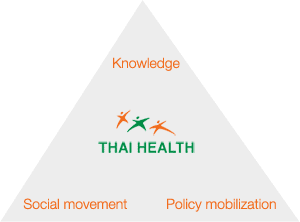
The THPF attributes their success to the "Triangle that Moves a Mountain"-strategy. Basically it is the implementation of policy making based on scientific studies and motivated by social activism. For instance, they would provide scientific studies showing how advertising aimed at the youth creates young smokers. Then they would get social groups motivated against such advertising, which in turn will persuade the government to implement policies against cigarette advertising aimed at the youth.


After lunch Dr Pat Chatiketu, director of the THPF’s brand communication, spoke to us about one of the projects called “Sweet Enough.” This project focuses on reducing the amount of refined sugars consumed by children. You can visit the Sweet Enough website at Maikinwan.Com, although it is mostly in Thai. As part of the Sweet Enough campaign, they have a mascot called Noynoi – a little pink ant that prefers natural healthy foods over processed unhealthy foods. With an arsenal of Noynoi books, games, and videos they entertain and educate children in the ways of better health.


That afternoon we left for Saraburi to join the Seangwittaya Elementary School where they have implemented a No Sweet Food Project into their school curriculum, based on the THPF’s “Sweet Enough” concept. It was quite heartening to see such active promotion of healthy living amongst the children. We were treated a little bit like celebrities, which I though unnecessary – we’re only a group of university lecturers and students wanting to learn more about health education in a foreign country – but I guess it was a way for the school to show off and be proud of the great work they are doing.

Thailand -- Natural Remedies and Herbs


The Health Education Practice Trip at the Mission Health Promotion Centre (MHPC) in Thailand includes a session on herbs. Most of the herbs discussed were plants indigenous to Thailand so it is not really relevant to us not living in South East Asia. I’ll just focus on some of the more common herbal and natural remedies discussed.

Many of the points mentioned focussed on cleansing the digestive track. One such a way is to start your day with a solution based on the juice of two freshly squeezed lemons and a teaspoon of healthy salt in a litre of lukewarm / room temperature water. Drink this first thing in the morning. This will flush your digestive system and cause bowl movement within a short time. Tea made of green papaya functions as a laxative and was also suggested as an intestine cleanser.

Another interesting cleansing concept, which I have not heard of before, is known as “oil pulling” – an ancient Indian natural therapy. In the morning, before breakfast, pour a tablespoon of cold pressed oil (e.g. sunflower, olive oil, sesame oil) in your mouth and swish it around in your mouth. The website Oilpulling.Com explains the process: “In the morning before breakfast on an empty stomach you take one tablespoon in the mouth but do not swallow it. Move Oil Slowly in the mouth as rinsing or swishing and Dr Karach puts it as 'sip, suck and pull through the teeth' for fifteen to twenty minutes. This process makes oil thoroughly mixed with saliva. Swishing activates the enzymes and the enzymes draw toxins out of the blood. The oil must not be swallowed, for it has become toxic. As the process continues, the oil gets thinner and white. If the oil is still yellow, it has not been pulled long enough. It is then spit from the mouth, the oral cavity must be thoroughly rinsed and mouth must be washed thoroughly. Just use normal tap water and good old fingers to clean.”

One of the main focuses of this session on herbs was consuming lots of chlorophyll. It is similar in composition than blood, but the base element is not iron, but magnesium. For this reason, chlorophyll is a powerful alkalinizer. Chlorophyll juice can be made by blending green leaves (e.g. spinach) in a food processor. This juice can be made more palatable with coconut or lime juice. Over the last couple of months I’ve personally started the habit of making “Green Smoothies.” I blend different greens with soy milk. I also add a banana or two to give it a “smoothy” consistency. I usually have a Green Smoothy as part of my breakfast.

A more common herb discussed was turmeric, which is an anti-oxidant, anti-inflammatory, and liver stimulant. I’ll definitely be adding more turmeric in my cuisines. They suggested adding it to my milk, but I’m not sure if I’m up for that.

A natural remedy I have never heard of before is distilled organic Wood Vinegar, which is good for fresh wounds, pimples, burns, mouth sores and skin conditions. On the Internet I found out that it can also be used internally, although we didn’t discuss internal uses at MHPC. It seems like a good remedy to have in one’s medicine cabinet, so I bought me a bottle.

Thailand -- NEWSTART

The Health Education Practice Trip to Thailand was not merely a vacation, but an educational excursion focussed on public health and included focus on natural health therapies as well as health education promotion. On the Monday, Tuesday and Friday morning of the trip we covered hydrotherapy, calisthenics, massaging, and diet—specifically malnutrition. In this post I’m shortly going to cover “NEWSTART”.

The first health workshop started with the idea that generally health is a choice. With time people either accumulate health or accumulate disease, depending on how they increase or abuse their vital force. The health philosophy at the Mission Health Promotion Centre (MHPC) in Thailand is based on the NEWSTART Lifestyle Program which strives to create homeostasis (correct balance) in the person. (For years now, I have based the Health Principles for my Taekwon-Do group on the NEWSTART philosophy.)

The N in NEWSTART stands for Nutrition. At the MHPC the menu is plant-based, focussed on whole grains, seeds, and nuts. The hard shells of nuts, it is believed, is an indicator that we ought not eat too many nuts at a time. Further emphasis is put on fruits and vegetables. Fruits, especially, helps with fighting off the aging process because they are high in anti-oxygens. Inflammation and oxygenation contributes to aging, so consuming lots of anti-inflammatory and anti-oxygen rich foods are important. Foods should not be refined or too processed, and be rich in fibre. Meat and refined sugar is avoided.

Exercise is important for the health of the whole body, especially the respiratory (lungs) and circulatory (heart) systems. Exercise should include stretching and resistance training as well as moderate aerobic exercise. At the MHPC we got up every morning around 5:30 and met at 6am for around an hour of brisk walking in the beautiful surrounding areas. By the time we got back, everyone was ready for breakfast at 7am.

Emphasis was also put on Water and the importance of hydration. Apart from other normal physiological processes, the consumption of deep fried foods, salty and sugary foods all contribute to dehydration. Juicy foods (i.e. fresh fruits) are important. And of course, regular drinking of water – six or more glasses a day is preferable.

The importance of Sunshine was discussed. Not only was the value of vitamin D highlighted, but also the effect of light on ones mental health.

Temperance means moderation in the good things and avoidance of the bag things, including negative emotions like worry, anger, hatred, jealousy, and so on, which all lowers the immune system.
The value of fresh Air was repeated. We looked at breathing exercises and also laugh therapy.

Rest and Relaxation was stressed, focussing on around 7-8 hours of daily sleep. Over sleeping is to be avoided just as much as under sleeping.

The last T, refers to Trust in the Divine.

Thailand -- Day One, Mission Health Promotion Centre

The Saturday evening before I left for Thailand I arrived home quite late. I still had some packing to do and so did not go to bed at all. Around 4:30 that morning I left for Nowon, an area in Seoul about 20-30 minutes from where I live. From there some friends and I were able to catch an Airport Limousine, basically a shuttle bus that commutes between the airport and certain stops in Seoul.

I was quite tired by the time the bus came but it wasn’t comfortable enough to nap properly on the way to the airport. At the airport we met up with the rest of the sixteen people whom went together on the “Health Education Practise Trip to Thailand.” The members included students and lecturers from the masters course in Public Health, some family and friends, and me. I went along as another representative lecturer from our university and because natural health therapies are one of my big interests.

On the plane I didn’t get much sleep either and the two hour van ride to the centre we would stay for most of the week was also quite uncomfortable.


At long last we arrived at the Mission Health Promotion Centre (MHPC), in Muaklek, Saraburi Provence. The MHPC was a wonderful surprise. We didn’t expect anything like this at all. It set in a lush tropic setting, with beautiful facilities. The air conditioned rooms were luxurious, the food delectable and the swimming pool lavish.

It has been years since I last had such a great time swimming. I grew up on a farm where we had a nice big swimming pool, as well as a natural dam, where I could swim to my hearts delight as a child. Having grown up with a private swimming pool, I’m somewhat spoiled with having so much water space for oneself. In Korea the public swimming pools are uncomfortably crowded so I haven’t had an opportunity to swim in a big swimming pool like this in years. The last time I was able to spend so much time in the water was in 2003 when I lived in a holiday resort that had a swimming pool, albeit not a very big one.

The MHPC focuses on healthy living and serves a completely vegetarian, nearly vegan, menu that uses very little oil. The food blazed with Thai herbs and flavours. I haven’t enjoyed eating this much in a very long time. Korean cuisine is rather bland compared to Thai food. There is also a grand variety of tropical fruits. Many of the fruits I had there for the first time, like custard fruit, durian, jack fruit, dragon eye, and others of which the names escaped me.

Thai Health Promotion Foundation

This coming week I'm going to visit Thailand. I'm going with a group of graduate students that will be doing their practical course work in Thailand in association with the Thai Health Promotion Foundation. I'll be joining with them in many of the classes and outings and look forward to it as much of the course will be on natural remedial health care, which is a personal interest of mine. I also hope to do some sightseeing and intend to visit one of the local Taekwon-Do gyms.

The Thai Health Promotion Foundation is doing wonderful work in Thailand in creating healthy living awareness. They also have hilarious advertising campaigns. Watch the video below to get a taste of it:

Uiltjies knip en sulke dinge

Image Source: Richard Oshen's Blog; Original artist unknown.

Ek het tot die gevolgtrekking gekom dat ek oorwerk / oormoeg is—dat ek moontlik te hard oefen of te veel hooi op my vurk het. Of eerder, dat ek nie genoeg rus in kry om op te maak vir die druk van my werk, projekte en oefenregime nie. Ek het bewus geraak van ’n duidelike patroon. Sodra ek ’n gewigoptel-oefeningprogram by my gewone oefen program voeg, raak ek siek. Ek doen tans vier maal per week offisieel krygskunsoefeninge: Maandag is Hapkido, Dinsdag en Donderdag is Taekwon-Do, en Vrydagmiddag is Braziliaanse Jujitsu. En soms op die ander dae doen ek ook ’n bietjie ander aktiwiteite. Met hierdie stel oefeninge blyk ek instaat om die mas op te kom. Maar sodra ek begin om gewigopteloefeninge in te sluit—gewoonlik op ’n Sondag—raak ek siek. Dit het nou al met genoegsame repetisies gebeur dat ek die patroon kon indentifiseer. Blykbaar vereis die gewigoptelsessies baie meer hersteltyd, maw baie meer rustyd. Dis nou al drie weke ek ek is nog steeds nie klopdisselboom nie. Die hoesery is darem tot 'n einde, maar my keel is steeds seer.

My huidige sowat ses ure per nag is nie genoeg nie. Ek besef dat my liggaam eintlik nege ure verkies. Wanneer ek nie myself met ’n wekker opjaag nie, dan slaap ek gerieflik sowat nege uur, daarom dink ek dat my liggaam eerder nege ure as ses ure soek. Maar goeie genugtig, waar gaan ek nege ure in die hande kry? Party aande kom ek eers half-elf, elfuur by die huis en daar is geen manier wat ek onmiddelik in die bed kan spring nie. ’n Mens moet eers bietjie afwen. En selfs al kon ek onmiddelik in die bed klim gun dit my steeds nie nege ure se slaap nie – slegs agt ure. (Agt ure is natuurlik beter as die huidige ses ure; hoe ookal, dis nie tans moontlik om eens agture slaap te kry nie.)

Ek dink die oplossing (of ten minste die tydelike remedie) is om dagslapies te neem. Ek moet bieg dat ek knip nie graag uiltjies nie. Dis grootliks my pa se skuld wat ons kinders sleg gesê het as ons in die dag slaap. Ondanks ek al jare op my eie is (nie meer onder my ouers se invloed / dak leef nie), voel ek steeds skuldig as ek in die dag slaap. Nietemin, die siesta is tradisie in vele bevolkinge van die Mexikane tot die Grieke. Ek onthou toe ek in Griekeland was hoedat winkels helder oordag toe maak vir ’n paar ure se middagrus. Ek het ook bietjie opgelees omtrent “napping” en dis duidelik dat dit gesondheidswaarde het. Dagslapies was glo “critical” vir Lance Armstrong se suksesvolle fietsoorwinnings. Ek gaan maar eenvoudig net my skuldgevoelens onder die bed in moet skop en bietjie slaap in kry deur die dag. My werksprogram laat dit natuurlik nie elke dag toe nie, maar daar is party dae wat ek ’n uurtjie kan afknyp. Gelukkig is my woonstel slegs vyf minute se van my werk af, so my bed is gerieflik naby.

Intussen probeer ek baie hard om in die gewoonte te kom om teen middernag in die bed te wees. Ek hoef nie noodwendig te slaap nie, maar ek moet in die bed wees met die lig af. Dit is natuurlik makliker gesê as gedaan. Teen tien uur die aand kry ek my tweede asem. Dit is asof ’n helderheid my beet pak en ek met nuwe oemf kan begin werk aan iets. En dit is dan ook wat ek baie kere doen. Vele aande wanneer ek by die huis kom dan begin ek werk aan iets en voor ek my oë uitvee is dit twee ure later en lank na middernag. Die ideale job vir my sal eers tien uur of elf uur die oggend begin.

Intussen, die volgende twee doelwitte: 1. middagslapies; 2. in die bed teen middernag.

Nadat ek die bogaande geskryf het besef ek skielik dat hierdie geensins 'n unieke skrywe is nie. Ek het basies presies dieselfde geskryf verlede jaar September. 

'n Tawwe kiem

Ek is siek.

Ek kla nie maklik oor siek wees nie. Wat ek bedoel is, ek mag dit dalk noem, maar is nie geneig om daaroor te neul en te kerm en aandag te soek nie. Op 'n baie vroeë ouderdom het my ma my geleer om na myself om te sien. As daar iets fout met my was het sy my verwys na die medisynetassie sodat ek vir myself 'n pil kon uithaal en dan gaan jy maar aan met jou lewe. Selde is ek gepamperlang as ek siek was. (Daar was 'n stadium toe ek 'n baba was, kort na my geboorte, wat ek baie siek was en my ouers in die hospitaal by my gewaak het, maar daarvan het ek geen herinnering nie. En die keer toe die reuse televisie op my geval het en 'n gat in my kop gekleef het; daarvan onthou ek ook niks nie.) Ek onthou seker een of twee kere waar my ma my werklik "vertroos en vertroetel" het terwyl ek siek was. Een keer was toe ek vir 'n operasie gegaan het om my mangels te verwyder. 'n Ander keer was toe ek voedselvergiftiging gehad het. Maar vir die gewonde kinder dinge: snye, skrape, en ander dinge wat plaaskinders betref moes ek maar self die wonde afwas en plysters plak. Oor die algemeen, vir algemene pyne en kwale wat kinders oorkom het my ouers my nie onnodig opgepiep nie. Ek het dus nooit aangeleer om aandag te soek deur siek te wees nie. (Dit is mos die stereotiep dat mans hulpelose babas is wat die heeltyd aandag en pamperlang moet word wanneer hulle siek is.)

So wanneer ek meedeel dat ek siek is, dan moet dit my nou al genoegsaam geirriteer het dat ek dit enigsins nodig vind om dit by die naam te noem.

Ek drink nou al daagliks duisende milligramme Vitamien C, gorrel my keel met lou soutwater, smeer bloekbalm op my bors en keel, drink liters water, maar dit blyk dat my verkoue wat sowat twee weke gelede begin het nou net erger word. My keel raak seerder en my hoeserigheid vererger. Gisteraand het die hoes my uit die slaap gehou. Die kuggie is konstant en frustrerend. My stem klink effens rou -- gelukkig nie hees nie. (Want hoe sou ek my werk kon doen met 'n heesstem?)

Ek het selfs Donderdag apteek toe gegaan en iets gaan optel. Die apteker het 'n reeks pille gegee wat ek in drie dae moes voltooi.  Saterdagaand het ek die laaste pil gesluk. Geen verbetering nie.

Ek verstaan dit nie. Hoekom het hierdie kiem die oorhand? Is ek oorwerk?

Ek het besluit om vir middagete na 'n spesiale restaurant te gaan waar hulle 'n dik ginsengsop maak. Hierdie tipe sop word "jook" genoem in Koreaans.

Dalk help dit. Daar naby is ook 'n groot supermark waar ek suurlemoene kan koop en varsgemmer. Ek het heuning. Suurlemoen, gemmer en heuning maak 'n goeie hoesstroop. Ek het ook bloekomolie waarvan ek 'n paar druppels in die mengsel sal gooi om die lugweg te streel.

Maar ek het soveel werk om te doen. Dalk kan ek van my merkwerk saam neem en in die restaurant sit en merk.