Showing posts with label korean culture. Show all posts
Showing posts with label korean culture. Show all posts

Aegyo: Korea's Cute Coquette
In Korea there is something called "aegyo". They translate it as charming, which is definitely not the best translation. Aegyo is basically when an adult acts childlike in order to come over as cute. It is usually done by women, but men sometimes do aeqyo too, particularly in the early stages of a romantic relationship. Aegyo is basically acting cute coquettishly. This is probably a good translation for aegyo: "cute coquette." Korean women usually do aegyo to break her male target's resistance as she manipulates him to do her will.
I get that aegyo is cute. I also like cute things -- a cute kitten can melt me in a second. What I don't get is why aegyo is sexy. Korean men actually thinks it is sexy when their girlfriends act like little girls. Personally I'm completely put off by it. I find the nagging-manipulation of aegyo, like any type of emotional manipulation, distasteful. Also, that men should find such childlike behaviour sexually exciting borders on paedophilia, I think. (I cannot help but wonder if there is a correlation between child sexual abuse and a culture that views childlikeness sexually attractive. I couldn't find much information on the topic; this post by The Grand Narrative may be a start.)
As I mentioned earlier, aegyo is not exclusively used by Korean women. Korean men also do aegyo, as the videos below demonstrate.
However, male aegyo sometimes works the other way. Instead of an adult trying to act cute, a young man could act more mature, self-confident or tough towards a female that is his senior. The following video illustrates this:
I've often been asked about my interest in Korean women and why I don't yet have a Korean girlfriend. There are different reasons, but one is that I really do not find aegyo sexually attractive. On some isolated occasions I thought it cute, and can appreciated it as an interesting cultural phenomenon. However, sexually it is a turn off for me. I definitely find mature women attractive, not little girls.
But, let me not be too hypocritical. I've done aegyo myself on occasion, because I know the results it gets in this culture. Also, apparently I speak Korean very cute. The reason is two fold. First, my Korean ability is quite elementary so I end up sounding a little like a toddler clumsily putting together sentences and we all know how cute that can be. Second, I used to learn much of my Korean from women, so I ended up speaking like the girls whose intonation I copied. Therefore, I'm often doing aegyo without it being my intention. I've started watching how Korean men act tough in Korean films and have tried that instead, but from the reactions of some of my students I think it came across as the reverse aegyo that men sometimes used, which I spoke about earlier. While I'm not a fan of aegyo, I catch myself sometimes being an aegyo culprit.
I get that aegyo is cute. I also like cute things -- a cute kitten can melt me in a second. What I don't get is why aegyo is sexy. Korean men actually thinks it is sexy when their girlfriends act like little girls. Personally I'm completely put off by it. I find the nagging-manipulation of aegyo, like any type of emotional manipulation, distasteful. Also, that men should find such childlike behaviour sexually exciting borders on paedophilia, I think. (I cannot help but wonder if there is a correlation between child sexual abuse and a culture that views childlikeness sexually attractive. I couldn't find much information on the topic; this post by The Grand Narrative may be a start.)
As I mentioned earlier, aegyo is not exclusively used by Korean women. Korean men also do aegyo, as the videos below demonstrate.
However, male aegyo sometimes works the other way. Instead of an adult trying to act cute, a young man could act more mature, self-confident or tough towards a female that is his senior. The following video illustrates this:
I've often been asked about my interest in Korean women and why I don't yet have a Korean girlfriend. There are different reasons, but one is that I really do not find aegyo sexually attractive. On some isolated occasions I thought it cute, and can appreciated it as an interesting cultural phenomenon. However, sexually it is a turn off for me. I definitely find mature women attractive, not little girls.
 |
| A bad aegyo moment. Sorry. |
Ho-ddeok
A short video I took of ajumeoni (Korean aunties) making ho-ddeok, a sweet pancake filled with brown sugar, cinnamon and crushed nuts and other secret ingredients.
The music is by Kang San Ae.
The music is by Kang San Ae.
Wangdda -- Korean Outcasts
 |
| Image Source |
I never expected it to continue into adulthood. The two wangdda are not bullied, but they are completely ignored. While this ought not generally be a problem, it is whenever I require students to do group work. I would assign these students into groups, but find that the other students completely ignore them. Once the groups had to do presentations and I think I heard this one group actually telling the one student not to come to class during the next class. I might be mistaken because my Korean is not that great and I wasn't standing close to the group when they spoke, but that is what I thought I heard. It is a big challenge to teach a class where such covert ostracising is occurring, especially a skills oriented class like Conversational English that constantly require pair work and group work.
In an individual society it is difficult to be ostracised, but individuality is often celebrated so that once you are an adult, it becomes okay. I remember that in school I was sometimes ostracised for being the weird, sensitive, artistic boy. As I got older it became easier, and by the time I went to university I found out that there were many other freaks just as weird as me and I made a great group of odd and creative friends. In Korea it is different. There are not that many subcultures and students that stand out as individuals are actually quite few. In fact, I often encourage and compliment any students that show originality and uniqueness, since these are values that I treasure and are probably undervalued in Korea. There's a famous idiom in Korea: The nail that stands up gets hammered down. I try to build up those lonesome nails; hopefully they'll survive the hammering if someone valued them enough.
Read more about wangdda here,
What's in a Name?
 |
| Image Source |
Personally I think it is all hogwash and suspect that it is not much different from numerology or other such superstitions.
Then again, there is much to be said for a name. Would Oprah have been the success she is today were her name Mary-Sue? Would Madonna have been equally iconic if she was known by her middle Louise instead? Or if she hused her family name and was known as Madonna Ciccone?

I once had a friend who were verbally and physically abused by her father. As an adult she decided that the negative associations with her name--her father always shouting her name--disturbed her, so she took up another name. She wanted a unisex name so we decided on Toni. With her new name, signifying a new start and a strong character, Toni was able to commence her journey of recovery after years of abuse.

Similarly, my younger brother who has a four syllable first name that people always mispronounce decided to shorten his name to a two syllable name. Later still, his friends adopted a one syllable nickname, Nate, which most people now use. While I liked the two syllable name, Nethan, I also like the name Nate. These days I see that he use different versions of his name, the original four syllable one, the two syllable one, and the one syllable one, in different situations, to good effect.
I'm sure that my own name also had an influence on who I am today. My real names are proper English names. However, our nanny gave me a Sesotho / Tswana name, which ended up becoming the name my family used. I grew up with an African name, which always made me stand out within white contexts. I'm sure this must have had an influence on how people treated me, and how I interacted with people. (If you want to know my name, you can see it on my poetry blog: Ingelegde Lywe.) In Korea my name is very similar to a common Korean name 상국, so that Koreans always ask me after I introduced myself to them if it is my Korean name, then I always have to explain to them, no, it is an African name, I am from South Africa. It has become such a trite routine, that I am shocked when it doesn't happen. Since my name sounds Korean I have opted to use 이상구 Lee Sang-Goo as my Korean name.
 |
| Image Source |
While I still think that the Korean Sound Name Wave Institute is a sham, I agree, that there is much to be said for a name.
Korea's Drinking Culture and Why I'm a Teetotaller
Saturday night and Sunday I spent with a group of mostly Koreans and some foreigners at a martial art excursion. This had not been my first such an outing with Koreans, so I expected there to be a lot of drinking and therefore prepared myself psychologically for it. As I am a teetotaller, I need such preparation. In general, teetotallers are a minority, but here in Korea with its extreme drinking culture teetotallers are almost non-existent.
 |
| Sometimes they start 'em young. Image Source |
 |
| A drunk Korean passing out in public. Not that uncommon a sight, actually. Image Source |
There are some Korean subcultures that do not drink, whom are part of so-called sectarian faiths such as Seventh Day Adventists, Jehovah's Witnesses, and Mormons. Because these Koreans are part of their own communities they at least have a social life. Koreans who do not belong to such religious persuasions are, as I mentioned already, ostracised and struggle to make friends. Even Koreans from these religious groups have a hard time, particularly in their work place. It is customary for colleagues to go drinking together after work, and refusing to do so, particularly if one's senior or boss suggested the drinking, is considered terribly rude, and even disrespectful. In that sense, not drinking could sometimes cost you your job.
 |
| Bottles of soju -- Korea's most famous alcohol comparable to vodka. Image Source |
 |
| Two older Korean friends passed out on the street together after a night of heavy drinking. Or, at least, that's my assumption of this picture. Image Source |
There is a small movement amongst upper class Koreans to drink wine. Since whine is so expensive, and since it is enjoyed slowly, wine drinkers tend to drink far less. Wine drinking in Korea is in many cases just for pompous show, like wearing a very expensive name brand suit, and going to art exhibits just for the pretence of appreciating art, but at least wine drinking is giving a way out to some Koreans who would like to socialise without getting completely knackered.
 |
| Soju advertisements usually involve a sexy Korean woman, showing lots of skin and curves, that enjoys to drink and party. There is undeniably a sexual connection made with drinking soju. |
 |
| Luckily for this girl, Korea is relatively safe. Image Source |
So why don't I drink alcahol? There are a couple of reasons really. The first reason I do not drink is as a statement. It is for the same reason I do not smoke. My father did. He smoked and it made him stink and I swore that I would not be like him. There was also a patch during which he drank and became aggressive. I remember clearly how my brother and I would hide (and sometimes throw away) his whiskey because of how we hated the way it changed his personality. It took him a while, but he eventually realised the negative impact his drinking had on us, so he stopped excessive drinking. I respect him for caring enough for us to choose us over the bottle. Nonetheless, the negative associations with alcohol was set, so I also swore not to be like my father, who continued to drink socially. Second, many people on my maternal side of the family are alcoholics. In particular my uncles, one of them my godfather whom I always looked up to. I saw how the drink had destroyed both their lives and their families and it disgusted me. It also came as a revelation to me that since I take after my mother's side of the family, I probably have a predisposition towards becoming an alcoholic myself. I know I have an addictive personality, so I'm not taking any chances. Later, when I became a Christian and accepted the scripture that says our bodies are temples of the Holy Spirit and that therefore healthy living is part of our act of worship, I decided to live a healthy life style. This is in part the reason why I'm a (flexible) vegetarian, why I avoid frequent consumption of caffeine, why I exercise even though I often do not feel like it. Finally, I honestly do not like the taste of alcohol. I once tried to drink Amarula Cream, thinking that I'd at least enjoy the taste since a like fruity, creamy stuff. I do like cherry liqueur dark chocolates after all. Regardless, I had to boil the Amarula Cream for quite some time to get rid of the alcohol taste. Last year I was in a hotel by myself and there was beer in the bar fridge. Being alone I thought I'd just try it a bit--I'm far from anybody who knows me, nobody would know. I took maybe two sips and can still honestly say that I really dislike the taste. If it is indeed an acquired taste, it is a taste I'd rather not acquire.
I'm not against people temperately consuming alcohol. There are many people who seem able to enjoy it in moderation only. Although I do not, many of my friends enjoy a drink on occasion. I am, however, against drunkenness and am definitely against Korea's excessive drinking culture. I strongly believe that Korea would be much better off without this element in its society. It is complete nonsense that a person cannot have fun without alcohol, that one cannot be sociable without drinking. And if it is the case for some timid people who needs the bravado of the bottle, the severe price Korea and its families are paying because of alcohol is not worth it.
In this post I focussed on a very negative aspect of Korea, sure. There are, however, many other positive things about Korea otherwise I would not have lived here for nearly five years now. Korea is cool.
11.11.11

This year, however, November 11th is extra special in Korea as children born will have identity numbers that start with "111111". To ensure that their children have a sestet of ones in their identity numbers many pregnant mothers have gone out of their way to get c-section surgeries scheduled for today. According to Reuters, c-sections scheduled for 11 November 2011 is up by 20% from usual. (I'm obliged to a South African friend for sending me the link to the news article.)

In Flanders Fields -- John McCrae
In Flanders fields, the poppies blow
Between the crosses, row on row,
That mark our place;wait and in the sky
The larks, still bravely singing, fly
Scarce heard amid the guns below.
We are the dead, short days ago,
We lived, felt dawn, saw sunset glow,
Loved, and were loved, and now we lie
In Flanders fields!
Take up our quarrel with the foe:
To you from failing hands, we throw
The torch; be yours to hold it high.
If ye break faith with us who die
We shall not sleep, though poppies grow
In Flanders fields!
The red poppie became the symbolic flower of remembrance.
In South Africa Poppy Day remembrance ceremonies are held on the Saturday nearest 11 November and some services are also held on the adjacent Sunday. It is not a national holiday, so I'm not sure how many people actually observe it, but it's function is similar to Remembrance Day or Armistice Day celebrated by countries of the Common Wealth and Veterans Day in the United States which is also celebrated on November 11th. South African's typically use Poppy Day to remember South African soldiers who died in WWI, WWII, the Korean War and Border War, as well as surviving veterans of war. Ceremonies are typically held in Cape Town and Pretoria.


11 November 2011 is also a day on which New Agers celebrate "Interconnectedness Day", with heavy focus on the Green Agenda. Previous such Interconnectedness Days were celebrated on 10 October 2010 and 9 September 2009. I guess next year on 12 December 2012 will be the last year Interconnectedness Day will be celebrated in a very very long time.
On a personal note, my first best friend, Matthys du Preez, and I used to celebrate 11 November as our friendship day. I can't remember exactly what the reason was that we chose this day as our friendship day, but we celebrated it as a birthday. Matthys was literally my first friend. I cannot recall any friend before him. Our parents were friends and because we were of the same age we naturally became friends. We also went to the same elementary school (a "plaasskool") together. We grew up on farms in the same farming community and there was only one elementary school where all the children in the community went -- a little school with hardly 300 pupils. We were so close in personality that many people mistook us as twins, to our delight -- I guess the fact that we often dressed alike contributed to it. We often finished each other's sentences and my mother told me that we seemed to communicate telepathically as we would sometimes just look at each other and seem to know what the other was thinking. Unfortunately my first best friend moved away when we were about 11 years old and due to the distance our friendship waned until we completely lost contact. In recent years I've started to increasingly think about my old friend. I was able to look him up and sent him an email with the hopes of meeting with him at the beginning of this year while I was in South Africa, but he didn't respond to my email. I guess he's not as sentimental as I am about those early years. In our late teens, early twenties, we both lost our mothers to illness. I think we could have been a great comfort to each other had we stayed in contact. I sometimes wish I could have been there for him during that time of loss and during other trials he may have experienced as a child. I have fond memories of our friendship and I remember quite distinctly the good and caring friend he was. I am very blessed with some great friends in my life. I have, in part, Matthys to thank for that. Because my first friendship had been such a very close one, that has become my expectation of a real friendship. Matthys' care and loyalty as a young boyhood friend inspired me to become the same type of friend later in my life.
Happy 11 November, for whatever reason you decide to celebrate it.
Lost & Found
 |
| Image Source |
I began to pray fervently. Utmost in my thoughts were the two cards and the student exam papers. The camera can be replaced, but the credit card can easily be exploited long before I can cancel it and I need my ID-card to cancel it. Also, the exam papers are irreplaceable and a dreadful mistake like losing my student's exam papers could seriously affect my job.
It was already very late so I wasn't sure what to do, but I eventually decided to just turn around and go back to the station where the previous train would finally stop. I got there just before midnight, likely close to closing time. After some searching I found the Lost & Found Office. My backpack was there with nothing missing.
While sending up prayers of praise I thought about how different Korea is from South Africa. There are many bad things I can say about Korea, but Koreans are far less likely to steal than the average South African. I've lost a number or things before, and got them back four out of five times, because of the honesty of the average Korean.
My negligence didn't come cheap, however. Because it was so late I missed the last train home so I had to find a motel to sleep over at. It cost me nearly $50. Had I known the area I probably could have found a jjimjilbang (sauna) to sleep at for far cheaper, but unfortunately it was way after midnight and I had to get to bed.


Holding a woman . . . uhm . . . I mean a bottle
 |
| "Black Bean Tera Tea" Image Source |
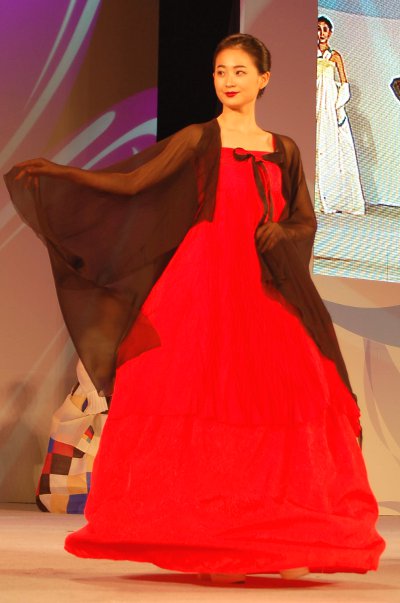
Modern Hanboks @ 2011 Gangnam Fashion Festival

I saw this beautiful collection of modern female hanboks (traditional Korean dress) at the 2011 Gangnam Fashion Festival on Monday.




Shaking Hands
 |
| Image Source |
I don't like shaking hands. Hands are tools and tools get dirty and exchanging tools is the same as exchanging germs. I am all too aware of where I put my tools, the places I scratch, the things I touch. For this reason I spare you the exchange of microbial spores and other germs -- please spare me from your filth too.
I really don't know why the ritual of shaking hands is still such a common practise. Personally, I'd rather hug somebody than shake hands with them. During a hug, there are layers of cloth separating actual skin-to-skin contact. Truthfully, it is not really the contact with another person's body that bothers me. It is touching someone else's hands. As I said, hands are dirty. It is our major manipulative tool. Even a cheek to cheek hug or a kiss on the cheek is more hygienic than a hand shake.
 |
| Image Source |
In Korea there are many an opportunity to share hand germs. In subway stations, escalators, buses and the like, are hand-bars to hold on to. I refrain from touching these at all cost. (My balance has improved tremendously!) Elevator buttons I often press with my wrist or the back of my knuckles. Doorhandles I open from behind my jacket, or with my knees. I push the handle to flush public toilets with my feet or with toilet paper wrapped around my hand.
Whenever I enter my home, practically the first thing I do is wash my hands.
A few months ago I gave a public speech on "Two 'Profitable' Things for a Christian from Romantic Poetry." For most the public speaking would be their worst fear. For me it was the idea of shaking hands with all the people afterwards. Even now I cringe at the thought.
One thing I appreciate about Korea is the bow. Bowing is not always a substitute for handshaking, but one can often get away with a bow instead of shaking hands. When I was in China recently, I was distraught that they don't bow.

To my friends, rather give me a personal hug, than shaking my hand. Or if the hug is too intimate for you, how about the fist-bump. With the fist-bump there is little exchange of germs and it looks cool to boot. Or let's bow. A friendly broad smile would equally suffice.
Aliens
If you could send a message to aliens (of the extra-terrestrial kind), what would you say to them? I like the letter by Hank of the Vlogbrothers to aliens. He does a really good summary of the human species.
If you are living in a foreign country, like myself, then the term "alien" is applied to you. My identification card in Korea states "Alien Registration Card".
So recently a fellow alien was videotaped while he was shouting in a bus and beating up an old Korean man. The video has gone viral in Korean online video sites like Daum TV-pot and has also made its way onto YouTube. The man apparently misunderstood the Korean guy who was saying something along the lines of 내가 여기 앉아, meaning "you can sit here." 내가, which means "you" is pronounced "nega" which sounds a little like "nigga", i.e. "nigger." So the African-American guy apparently thought the old Korean man was calling him a nigger and went bonkers. This is an apparent case of cultural miscommunication.
But not so fast. The African-American dude shouts back at the old man in Korean 개새끼야, which is the equivalent to "fuck you!" So this guy took the time to learn very offensive Korean swear words, doing it with perfect pronunciation, but he cannot understand something simple like 내가 여기 앉아?! Let's assume that this is true, that he doesn't know what 내가 means, but knows what 개새끼야 means, what does that tell us about his character? For him it was more of a priority to learn to cuss in Korean that to learn the simple pronoun "you"?
Don't tell me its because black people experience racial discrimination in Korea and so that excuses his behaviour. Just two days ago I again experienced racial discrimination myself on the subway. I went to take a seat next to someone in the train and immediately this Korean person got up and went to sit in another seat. I've experienced this enough times to see it for what it is -- racism. Yes, some Koreans are racist and not only towards black people. Still, even though I felt offended by the woman's behaviour I didn't shout 개새끼야 at her. Why? Not because I didn't feel offended -- I do -- but because that is not the kind of person I am. Let's, for the sake of the argument, assume that the Korean old man did call this African-American guy nigger. Does that really warrant that kind of rage and violence? Seriously, this guy needs some Jesus-Love to heal his heart, for he must have experienced the worst kind of racism, oppression, hatred and torture for that word to trigger such a reaction.
In one easy swoop this "tough guy" has reinforced the stereotypes of foreigners in Korea being unmannered, disrespectful and uncivilised. His actions has strengthened the stereotype against black people as violent and barbaric, and he has made my life and the lives of all other foreigner teachers in Korea much more difficult. I'm ashamed on behalf of all foreign residence in Korea. I feel serious pity towards all black foreigners that this guy is representing in the eyes of Koreans. Not to mention another stereotype, that of Americans as arrogant and bombastic also strengthened by this loud and dirty-mouthed individual.
Onto another alien: Lady Gaga. She came out with a rather nice country music-influenced song, "Yoü And I". Did you see the music video? Disturbing and sexy in a mermaid-fetish / Frankenstein-fetish / necrophilia kind of way. Apart from a secret mermaid fantasy, not really my kind of thing. I like, however, the cover by Korean-American David Choi and Lisa Lavie. Not two voices that I would have imagined to go well together, but they pull it off pretty well.
The most beautiful part of the song is that line: "muscle cars drove a truck through my heart."
An all time favourite "alien song" is Sting's "Englishman in New York". "I'm an alien, I'm a legal alien, I'm an Englishman in New York." I sometimes choose this song when I'm singing in a noraebang (karaoke).
A random post on random thoughts about random aliens would probably be incomplete without a list of some of the aliens I find most attractive: Leeloo from Fifth Element; Neytiri from Avatar; Sil from Species; Seven-of-Nine / Borg from Star Trek; T-X from Terminator 3; Leela from Futurama; Alien from Alien; and Captain Jack Harkness from Doctor Who / Torchwood.


Subscribe to:
Posts (Atom)